
[Please note, this post, like every post at The Self-Publishing Coach, was written by a human – me! – Alexandra Amor.]
In 2025 I sold more large print copies of my cult memoir than regular print copies. What’s the lesson here? If you’re not publishing in multiple formats it’s possible you’re leaving money on the table.
One book. Many ways to sell.
The book that you’ve written is not just one product, like a t-shirt or a car, that can only be sold once.
It’s something that is created once and then can be sold millions of times, as lucky authors have found out. I always feel for those artists who create things (pottery bowls, necklaces, wicker baskets) that can only be sold once. Granted, the price point for these things can be higher than that of a book, but still their nature means the artist creates one thing and then sells one thing.
Books, thankfully, are different. And this can mean good things for authors like you.
It doesn’t stop there
That one book that you’ve written can become several products which can then be sold in several different ways. This is ‘multiple streams of income’ at its best.
The image below illustrates some of the avenues for selling one book.
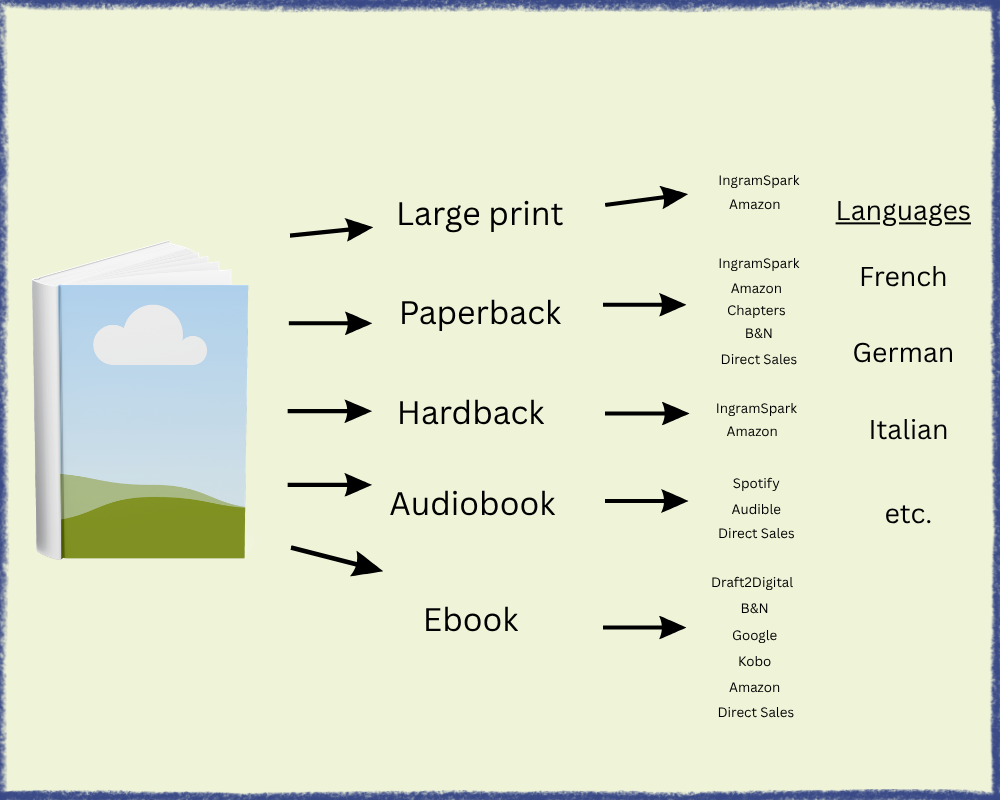
All the different formats in the image above are potential streams of income, which are then further divided into more streams of income when they are sold at all the online retailers. Further, we can do the same with different languages, especially with the recent advances in translation technology.
Even if your ebook is enrolled in the KDP Select program (and therefore is exclusive to Amazon) your paperback, hardback and large print format can be available at all the places mentioned in the graphic above.
Large print and libraries
Libraries are under served when it comes to large print books.
It is an added expense for a publisher, independent or traditional, to create a large print book. Though I will hasten to add that the expense is not that much greater. A formatter like myself can create a large print version of a book when they create your paperback and ebook, and as part of a package this should not add more than a few dollars to the formatting bill.
When libraries are looking to add to their large print collection their options are limited, much more than they are for ebooks and paperbacks. Therefore, offering a large print option for your book at IngramSpark means that libraries will be more likely to choose your large print book, as its one of the few available.
I approach hardback books with this same attitude. Hardback books last longer at libraries; they are more durable and can withstand more checkouts than the average paperback.
Where are you leaving revenue on the table?
I had a formatting client the other day who said he didn’t want an ebook version of his book. I didn’t press him but I did wonder about the reasoning behind this decision.
Sometimes authors make the decision not to publish in ebook because they don’t read ebooks. They are assuming that their potential reader has the same reading preferences as they do. But this is not always the case. Readers come with all kinds of preferences for how they read; some prefer audio because they have a long commute, some prefer ebook because they can control the font, which makes reading easier on their eyes, etc.
You are not your reader
A reader who only reads in ebook format, whether because of eye issues or simply preference, cannot purchase your book if it’s not in ebook. I have personally found books I wanted to read and when I saw that they were not available in ebook, backed away. That author lost a sale. (I personally prefer reading in ebook format and not having stacks of paperbacks in my small home.)
The numbers don’t lie
As I said at the beginning of this post, I sold more large print books on Amazon in 2025 than I sold ‘regular’ print books. If I hadn’t had my memoir available in large print I would have earned $0 from that format.
Are your books available in many formats? If not, is this something you would consider in the future?
This post, like every post at The Self-Publishing Coach, was written by a human – me! – Alexandra Amor.

Leave a Comment